Table of Contents
Introduction: A Name You’ve Probably Never Thanked
When you hear “Silicon Valley,” names like Steve Jobs, Bill Gates, or Elon Musk immediately come to mind. We celebrate innovators who bring products to market, yet rarely acknowledge the intellectual pioneers whose ideas made these innovations possible.
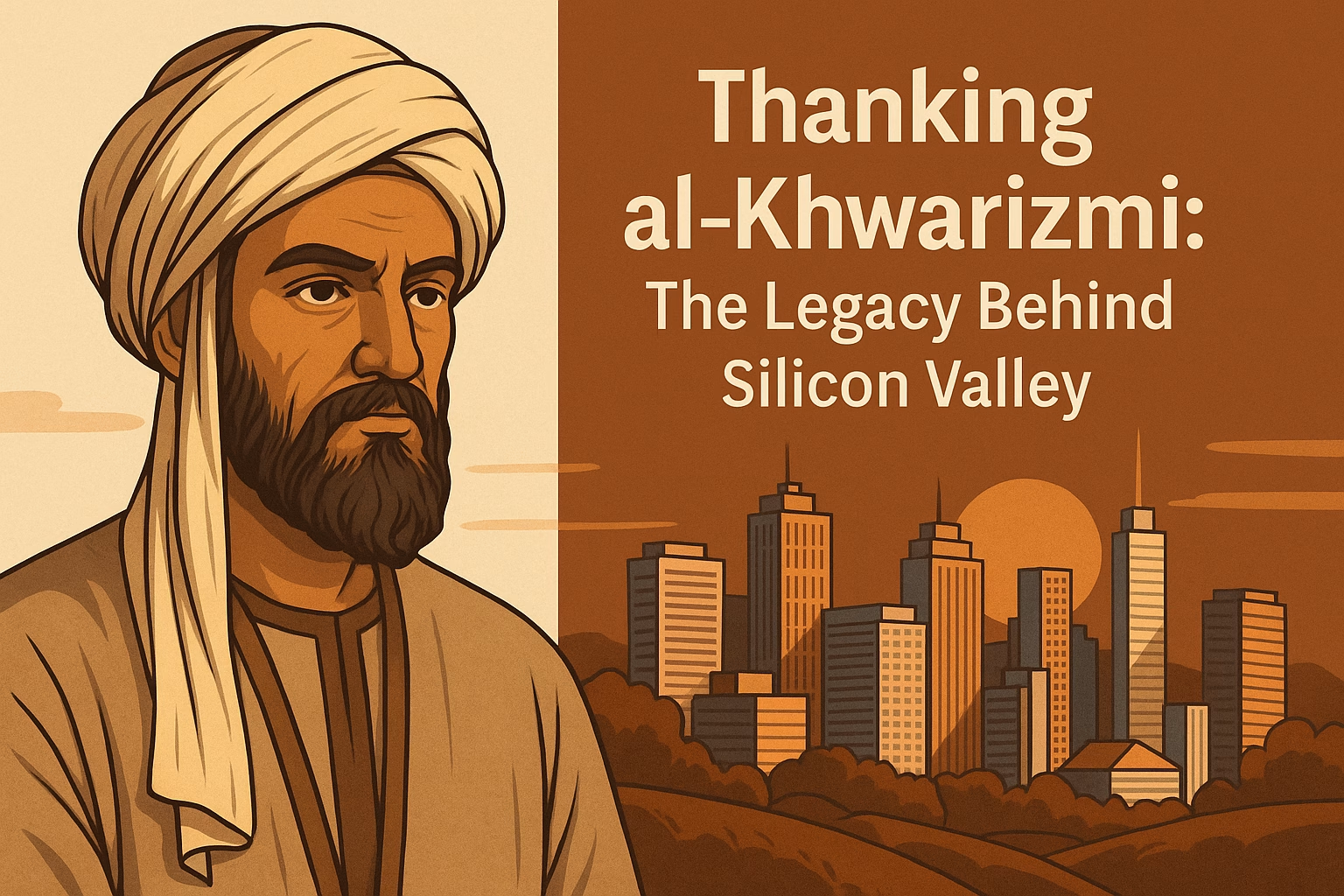
One such pioneer is Muhammad ibn Musa al-Khwarizmi, a 9th-century Muslim scholar whose work laid the foundation for modern algorithms and computation. In the age of AI, data science, and blockchain, his legacy underpins the very systems that power our lives today.
The Algorithm Has a Father—and He Wore a Turban
Al-Khwarizmi lived during the Islamic Golden Age, a period when the Abbasid Caliphate fostered knowledge across science, mathematics, and astronomy. His life was closely linked to Baghdad’s House of Wisdom, a center of learning and translation that attracted scholars from across the known world.
In his groundbreaking text, Al-Kitab al-Mukhtasar fi Hisab al-Jabr wal-Muqabala, he:
- Founded algebra: Introducing systematic rules for solving linear and quadratic equations.
- Defined computation systematically: His methods were the precursor to modern algorithms.
Fun fact: the word “algorithm” derives from the Latinized version of his name—“Algoritmi”. Every time your smartphone runs a search, your AI predicts your next word, or a blockchain processes a transaction, al-Khwarizmi’s thinking is at work.
The Silent Brick in Silicon Valley’s Foundation
Al-Khwarizmi’s influence is rarely celebrated in popular culture, but it is ubiquitous in technology today:
- Computer Science: His algorithms provided a systematic approach to problem-solving, influencing software engineering practices.
- Data Science & AI: Data processing, pattern recognition, and even machine learning logic build upon the principles of algorithmic thinking.
- Cryptography & Blockchain: Many cryptographic algorithms depend on modular arithmetic and algebraic structures, which trace back to his work.
Without him, modern computing as we know it—smartphones, AI assistants, cloud computing—would not exist.
Al-Khwarizmi’s Intellectual Legacy
1. Algebra: More than Equations
Algebra, or “al-jabr”, revolutionized mathematics by providing systematic methods to solve equations. This framework allows programmers and AI engineers to model real-world problems mathematically.
2. Algorithmic Thinking
Before al-Khwarizmi, calculations were largely procedural and manual. He introduced step-by-step methods, a clear blueprint for problem-solving that computers now execute automatically.
3. Number Systems
He played a key role in introducing Hindu-Arabic numerals to the Islamic world and later to Europe, replacing cumbersome Roman numerals. This numeral system is the backbone of modern computing.
Why the Modern Tech World Owes Him a Debt
- AI and Machine Learning: Training algorithms rely on structured step-by-step logic—exactly what al-Khwarizmi formalized centuries ago.
- Software Development: Any programmer following pseudocode or flowcharts applies his principles.
- Blockchain: Cryptographic protocols, hashing, and modular arithmetic are built upon the foundations he laid.
In short, Silicon Valley builds on shoulders of intellectual giants, and al-Khwarizmi’s are among the tallest.
Connecting History with Modern Innovation
Understanding al-Khwarizmi’s contributions shows us that innovation is cumulative. Technology is not born in isolation; it evolves from centuries of accumulated knowledge. Recognizing the roots of computation allows modern developers, engineers, and tech enthusiasts to appreciate the historical lineage of algorithms, ensuring we respect and learn from the past as we build the future.
Conclusion: Remembering the Forgotten Pioneer
Muhammad ibn Musa al-Khwarizmi may not appear in Silicon Valley boardrooms or TED Talks, but his impact resonates every time a computer solves a problem, a smartphone predicts text, or a blockchain transaction completes. He is the silent father of modern technology, bridging centuries between Baghdad’s House of Wisdom and today’s digital revolution.
By acknowledging his contributions, we not only honor history but also gain perspective on how knowledge builds upon itself, inspiring the next generation of innovators.
Image




Leave a Reply